
Progression
The sensorial progression, material by material
One quality at a time, in the order the album presents it.
The sensorial area is a sequence, not a collection. Each material isolates a single quality, and the sequence moves from the most concrete discrimination — size — through colour, form, touch and weight, to the materials that prepare for algebra and geometry.
Buying out of sequence is the most common mistake: a school buys the trinomial cube because it looks impressive and leaves the pink tower until next year, and the cube then has nothing to build on.
Materials in this collection
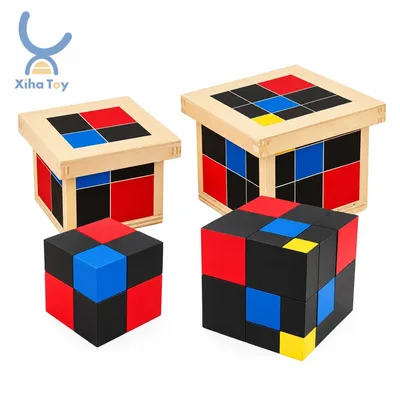
Trinomial Cube — Wooden Sensorial Material
Beech, pine and plywood · min. order 10 sets
View details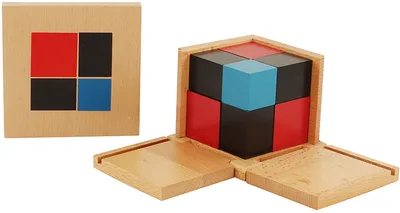
The order
| Stage | Materials | What is isolated |
|---|---|---|
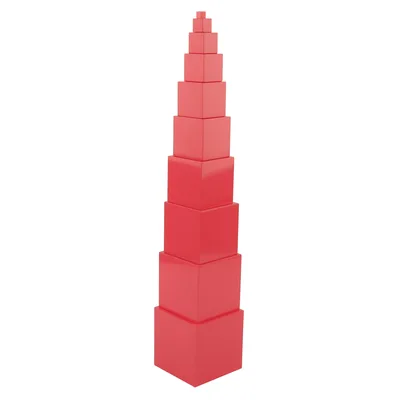
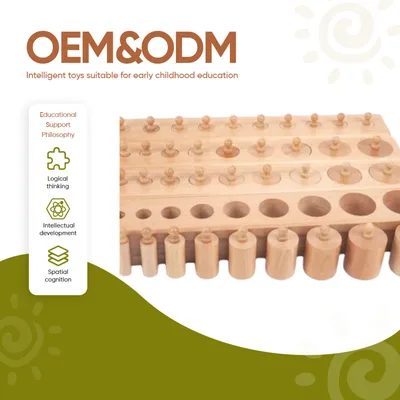
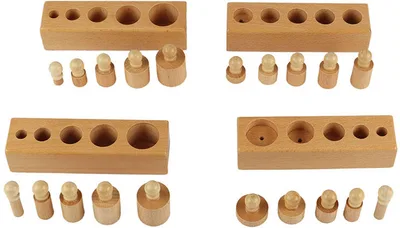
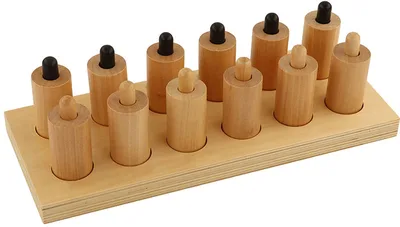
| Dimension | Pink tower, brown stair, cylinder blocks, knobless cylinders | Size in one, two or three dimensions |
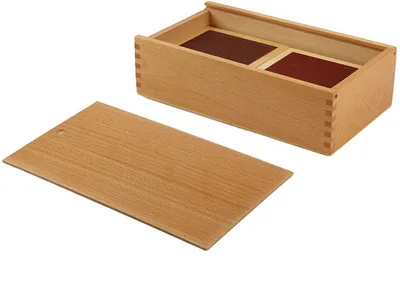
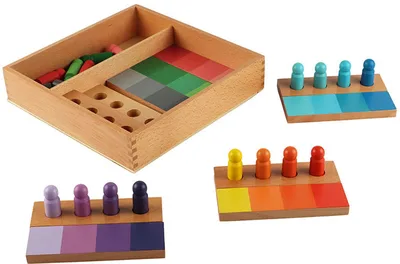
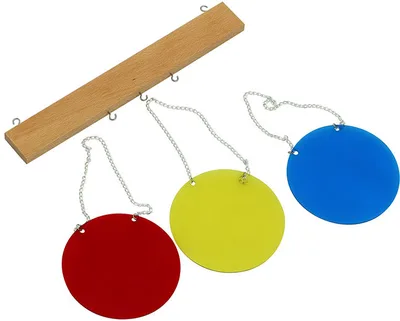
| Colour | Colour tablets, colour resemblance sorting, tricolour discs | Hue, then shade |
| Form | Geometric cabinet, demonstration tray, small geometric board | Shape and its edges and angles |
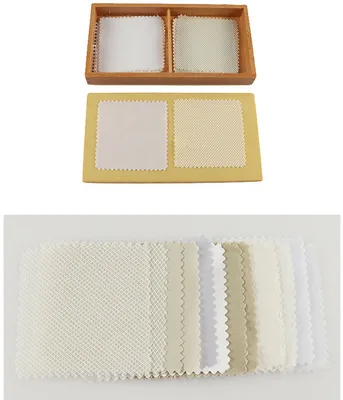
| Touch | Rough and smooth boards, fabric boxes, touch exercise | Texture |
| Weight and temperature | Baric tablets, thermic tablets | Mass and temperature |
| Sound and taste | Sound cylinders, tasting exercise | Volume and taste |
| Algebraic preparation | Binomial cube, trinomial cube | The structure of an expansion |
What each purchase buys
The dimension series buys the most work per euro: the pink tower, the brown stair and the four cylinder blocks are used daily for two or three years. The colour and touch materials are cheaper and are used for shorter periods, so they are the second purchase. The algebra cubes are the last, and they are the ones a school most often buys too early.
Where quality shows
In the dimension series, the tolerance is the quality: a millimetre of drift in the pink tower is visible to a child. In the colour materials, the consistency of the stain across the set is the quality. In the touch materials, it is whether the surface is applied to the edge as well as the face, because the edge is where it lifts.
Guides
Guides for this collection
How to Choose Montessori Materials for a School
A practical checklist for choosing Montessori materials: dimensions, timber, finish, knobs and fastenings, and completeness of sets.
ReadGuideInspection Standard for Wooden Montessori Toys
The inspection checklist we use before shipment: dimensions, moisture content, finish, joints, small parts, packaging and the AQL sampling plan.
ReadFAQ
Frequently asked questions
Which sensorial material should a school buy first?
The pink tower, then the brown stair and the cylinder blocks. They are the dimension series and everything else in the area refers back to them.
When is the trinomial cube presented?
Late in the 3–6 sequence, once the binomial cube is secure. It is a preparation for algebra, not an introductory material.
Curriculum areas
Areas this collection draws on
Planning a classroom, a container or a catalogue?
Send the models, quantities and destination market: a quotation follows in one to two working days.
Request a quote